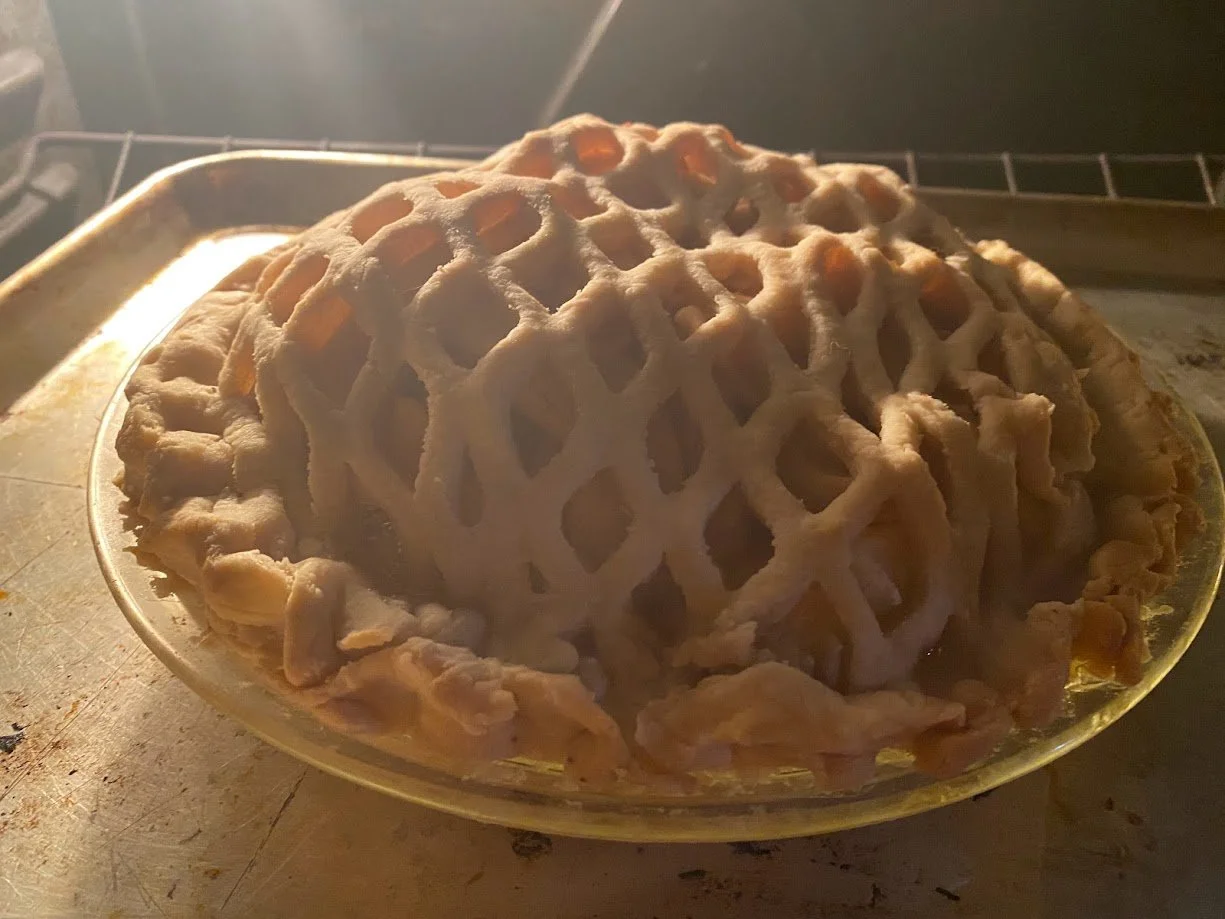
P.T.A. Pie Shame: A Slice of Island Life
Hidden beneath the surface of the picturesque town of Friday Harbor lies a tale of lost community. The challenge of garnering enough homemade pies for the P.T.A. Pie Booth at the San Juan County Fair proves a tragic reminder of an island divided. This concept of “otherness” and how it affects small communities is as multilayered as the flakiest pie crust found in our few donated pies. If you are reading this and it’s not the last day of the Fair, there’s still time for redemption! Go bake a pie and bring it to the Homemade Pie Booth! I’ve been doing pie penance since an online altercation, which made the most trivial request take on epic proportions. Baking an extra fruit pie and freezing it to thaw and donate during the Fair is my best effort to rebuild the community. Our rural Fair deserves to have homemade pies as a staple in the food court and a tradition everyone can celebrate.
The demographics of our rural island offer the first clue to unraveling the mystery of the missing community bakers. The middle class is effectively being priced out of the housing market despite the abundance of jobs. In the past, living expenses and available housing were not as big of obstacles for young families to hurdle. Now incoming families need to have a certain level of resources to navigate island living, creating a fractured community of the haves and have nots, the long time islanders versus the new residents who are either scrambling to make ends meet or hobnobbing with other like minds. It doesn’t leave much time for baking pies for the county fair. The influx of new residents, motivated by their vision of a tightly-knit community, leads to emotional as well as financial investments. When confronted with the petty realities of small-town living, these newcomers often respond with denial and exclusion to protect their dream.
What began as my seemingly benign request for homemade pies beneath the social media call for donations from the P.T.A. became a heard online argument, exposing the underlying human desire for recognition and belonging. The comments and responses illustrate the deep-seated animosity and resentments bubbling beneath the surface of our “close-knit community”. The pie shaming began almost immediately with a chirpy response from a local elementary school mother asking what pies I was planning on baking. I replied that my donated pie baking days were over but I supported the booth by buying pie and directing others to sample their wares. As a long-time volunteer and superintendent of the Zucchini 500, I have always extolled the virtues of the Homemade Pie Booth to fair goers and funded several hungry local kids’ pie treats. Being diabetic, I limit myself to one piece of pie and was disappointed last year when it was clearly store bought. I firmly believe the charm of the P.T.A. pie booth is, as the hand-painted wooden sign has advertised for decades, ‘HOMEMADE PIES”. Pie baking is a tricky endeavor and it’s always a crap shoot on the quality of homemade pie you will get on any given day, but that feels like a carnival game in and of itself. Throughout history, our island community thrived on gatherings that celebrated togetherness and the San Juan County Fair is the grandest celebration of all. The Fair serves as a melting pot that showcases diverse experiences, resilience and a community united. If a beloved icon such as the P.T.A. pie booth is in jeopardy, it is the canary in the coal mine and indicates deeper fissures in the foundation of our rural island.
Screenshots capture the extent of the online cruelty that erupted during the conversation thread underneath the donation request, portraying a community consumed by vitriol. What was intended to be a friendly request devolved into a battlefield of insults and personal attacks, further fracturing an already fragile environment. I was accused of making the donation post all about bullying and death and was told I was hateful and ruined everything. My exact words were initially, “No more store-bought pies, please.” It’s true that I did share our experiences with the local and private schools on the island during our son’s education, and it did involve bullying and feeling like outsiders in a small town. Despite being stalwart classroom volunteers and heading up our own creative arts program offering free classes to local kids, we got little support and felt unseen. So when a P.T.A. mom admonished me to be grateful we raised our son twenty-seven years ago, I choked a bit and shared what our experience had actually been. As for the death remark, when the same mom bemoaned how challenging it is living on the island with all the expenses and multiple children, I mentioned I did not have an only child, as his sister had died. I’ve always disliked only child stigma and assumptions. I suggested that pie shaming wasn’t the best tactic to get people to bake and donate pies, but she was adamant in her belief that I was “other” and she was confident in her judgment that I was just someone who complained but did nothing to help. The tragedy of the P.T.A. pie booth donation thread serves as a somber reminder of the importance of genuine connection, empathy and kindness in preserving the essence of a community. I sent the author of the initial post a heartfelt apology directly for causing her request to blow up.
My fellow Fair Board members are rallying behind the pie donation pleas and offering incentives like cute pins that say, “Do you want a piece of me?” with every online sign up, and I appreciate their sense of humor. The P.T.A. has opened an account at a local bank and is encouraging people to donate money to hire someone to bake pies. I have seen locals online balk at signing up because of their own sense of inadequacy in baking, which is understandable as I am a fair-to middling baker myself. In this world of Instagram perfection and highly curated depictions of daily island life, my rustic pies are barely suitable. Usually what they lack in finesse, they make for in flavor but not always. Baking is a fickle craft.
As the flour settles, it reveals how Friday harbor is a microcosm of the human experience with all its complexity, contradictions and potential for both kindness and cruelty. Until then, let’s raise our rolling pins and dare to bake quirky pies and donate them to a worthy cause. As we navigate our community changes and strive for inclusivity, it’s crucial to remember that each person’s contribution, no matter how imperfect, can enrich our collective experience.
Children & Animals
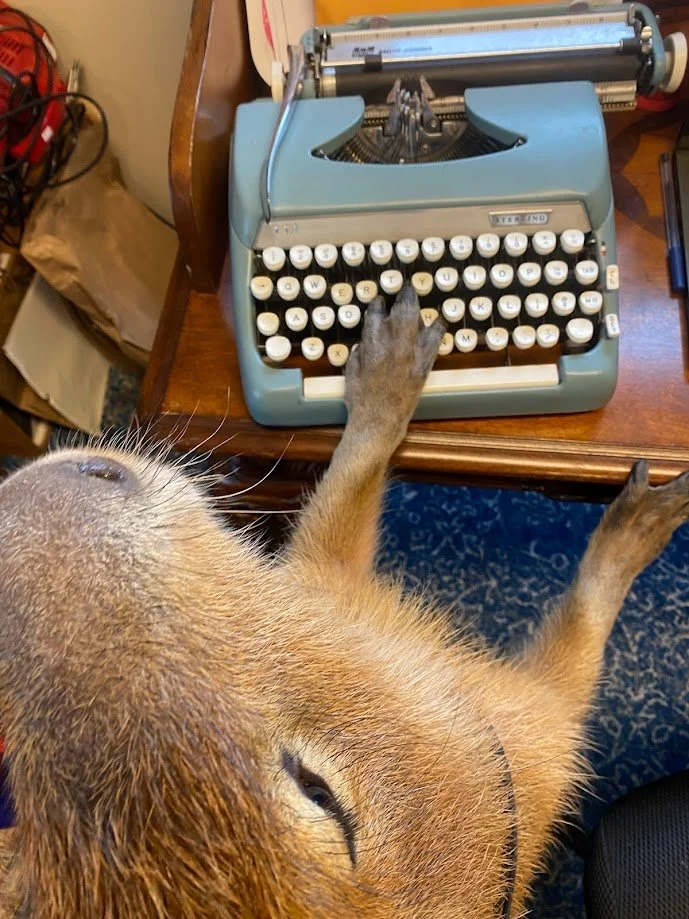
Antonio hard at work.
Despite W.C. Fields’ dire warning to never work with animals or children, my artistic path emerged from doing exactly that.
It started early. In a single-parent household, roles aren’t so much assigned as expected. By elementary school, the job of adulting had already been delegated and I was left in charge of my younger sister when she was a toddler and I was just ten years old. From there, one caretaking position led to another: Sunday school teacher, youth camp staff, daycare operator. The sort of well-meaning, low-paying gigs that attract people who mistake burnout for moral clarity.
Once our son went to elementary school, we started volunteering in classrooms and soon teaching after school enrichment classes for free. Then came the Fourth Grade Rock Band, followed by Rock Shop!, a well-intentioned musical mentorship to round out our dance, science and language creative arts program. Kids learned instruments, wrote songs, and felt like rock stars. Parents treated it like daycare with guitars. Next came Rock ShopZillah!, the summer camp version: vibrant, chaotic, and economically catastrophic. Rough math later revealed nearly $100,000 evaporated over ten years, due to our commitment to offer low cost opportunities to local kids. That explained the bank account with the permanent echo.
There was a belief, naïve but sincere that our “close knit” community would see our efforts and help. It didn't, although we threw ourselves into marketing, from handmade posters to grappling with social media content . Fundraisers bled money. Local blues musicians, feeling threatened by the kids' rock band success and popularity, asked local venues to blacklist us because they felt upstaged. No good deed goes unpunished.
Somewhere in that financial downward spiral, a newly transplanted island eccentric insisted the band participate in the inaugural recycled trashion fashion show at the county fair. She begged and called me for months to get my creative arts program kids on board.Packing material and old tarps were reimagined and turned into tunics and skirts after band practice. Spirits were high until dress rehearsal, where it became evident that what had been extended wasn’t really an invitation,it was a quota. Reasonable requests (like giving a young model time to change outfits) were treated as unseemly demands. The superintendent who had lobbied for their presence would not advocate for them in real time. Some of the girls in the band quietly disappeared after that. It was one of the many times I saw how easily kids under my mentorship could be dismissed, even humiliated, by adults who had promised support. That kind of lesson sticks.
Still, we refused to admit defeat. A young guitarist joined the band, to fill the emptiness the girls had left. His father, a cinematographer, after doing band photos and tagging along to several practices and gigs, suggested filming a music video. The more opportunistic of the parents swooned at the idea of their kids working with a famous cinematographer and started throwing their weight around and the more self absorbed ones ignored the opportunity entirely. Nevertheless, we worked toward our first video idea until he got sick. Tragically he died, leaving his two sons orphaned. The video didn’t happen, grief as always, scrambled the timeline and formed a new collaboration. His youngest son, our guitar player and I started making christmas music videos together once he was in college. Film school followed for me when I turned 50 after my partner had a near death experience.With so much loss around us, we knew we had to commit to our creative projects because time is not promised. Our guitar player grew into my favorite director of photography. Forward motion remained the only constant.
Meanwhile, on the domestic front: turns out living in an unfinished art studio doesn’t pair well with debt and structural rot. The solution required permits, a remodel, and several conversations with people who use the phrase “code compliant” unironically. Community programming hit pause. We had been giving all our time, energy and resources away to everyone else. One music video a year became the creative lifeline. My partner concentrated on building guitars. A screenwriting group provided structure for me and a much needed community of like minded creatives.
Then one of them suggested using a capybara in the next video. A Bill Peet book featured characters based on his pet capybara and had been among my partner’s childhood favorites, The Wump World, so it was an easy sell. A nearby petting zoo with a capybara named Eduardo was located. Using “Run, Run, Rudolph” our band recorded the song with our favorite sound engineer. Plonking antlers onto a capybara we had just met, we shot a music video at the end of the pandemic in a vacation rental and the petting zoo with our best kids camp talent and some film school friends.
Eduardo was delightful. The petting zoo was less so. Somewhere between coaxing him through scenes and glancing sideways at the tiny monkey in someone’s car, it began to seem like capybaras might be a pet we could provide a good life for and break the exotic pet owner tropes.
Months later, a wrong number connected back to the capybara contact. Thinking I was calling Melissa the choreographer for my next music video, I accidentally called Melissa the petting zoo owner. Her friend’s capybara had just had a litter. The idea of owning one, half absurd, half inevitable, was something we had conversations about over morning coffee or at the end of the day. What would we name him? Toby, Tony? The introduction call was brief: one male left named Antonio. We knew he was ours.
The exchange took place in a Costco parking lot. I joke that they are a seasonal item. Our son helped with the cost and we called it our anniversary present to ourselves. Antonio was seven weeks old and wide eyed. At home, he fell in love with Ripley, our older diabetic alert dog. She and the cats raised him and he nestled in next to her at the foot of our bed.. She tolerated him with quiet dignity and taught him how to go on road trips. She died before his first birthday. Everyone felt lost without her. Now he chases the new kitten around the house to show her who’s boss.
Capybaras grow and assert opinions, they can get to be over 175 pounds as adults. Anticipating that we chose to get him neutered at 6 months which was controversial in capybara owner circles because of how tricky they are under anesthesia. But in order to ensure his safety on set and in public, we thought it was best to nip any male aggression in the buds. It’s a common myth that capybaras are always gentle and get along with all animals. In reality, they can be aggressive and territorial. Training was also necessary for an animal actor destined for stage and screen. A Zoom-based exotic animal trainer provided guidance. Antonio learned to walk in a harness, spin, sit, jump through hoops, stay, touch, stand, walk upright and ride in a stroller. Costumes were permitted until they weren’t. Birthday hats are now out of favor. He has merchandise now, stickers, t-shirts, cards and totes as well as a yearly calendar. He also does Cameo appearances.
Then he went viral multiple times. From the time he arrived, he had taken over our social media feeds and I felt more compelled to create content daily but was overwhelmed. A call for volunteers was posted. Some local teens joined the ranks at the end of the school year. They were fresh and unfazed by the logistics of managing a semi-aquatic influencer.
A few weeks later, they were accompanying Antonio on the red carpet at the Seattle International Film Festival. One did the tiny mic interview with him. Meanwhile, we wrangled a 100-pound capybara in and out of his stroller to visit multiple theaters, delighting the staff.
SIFF generously provided passes, memberships, and tickets. We brought him to walk the red carpet during the festival to support our fellow filmmakers. Antonio left behind a trail of selfies, sticker swag, and amused strangers. We were celebrated and shared what was on his slate, narrating the Zucchini 500 documentary, starring in a post apocalyptic feature film and a new version of his hip hop music video dropping soon.
This was such a healing experience and full circle moment. Whereas kids we had mentored in the past had felt unsupported by our small community, these kids were able to bask in the attention of fellow filmmakers and share their interest in filmmaking and acting. Just a capybara with appeal, a team invested in this new venture and a creative life held together by stubbornness, humor, and potential.
Antonio provided a demographic that loved his journey. And by proxy, we as his partners gained more support for whatever mad capybara adventure we dreamed up next. And in following that lead, everything started to change.
The A Street house
The A street house...
The house on A street was the first proper house my partner and I had rented together, and I moved there newly pregnant. I ran a daycare as my home business, a role that seemed to suit our phase in life, so we set about making a picket fence around the place. We smuggled our favorite hen into the yard and tried to remain blissfully unaware of the town's ordinances. The house grudgingly accepted our presence, and we painted and nested and worked making it the hub of our businesses and soon-to-be expanding family. We used the downstairs bedroom across from the bathroom at the bottom of the stairs for the daycare nap room and guest room. It was on the shady side of the house and was perpetually dim, with a closet door that never seemed to latch securely.
During that peculiar time in our lives as I was waxing heavy with our first child, I was taking art classes, and the teacher insisted we do a series of self-portraits. Trying to squirm out of such wanton hubris, I drew myself in charcoals wearing a feathered mask. When I drew my eyes behind the mask, they scared me. I hid the sketch in the back of the guest room closet. I pulled it out later to show my friends; the eyes seemed to have taken a life of their own, shadowed behind the feathery façade. I always put it back, faced the corner, and tried to forget it was there. When we moved out of the house, we never found that picture.
After our baby daughter died, stillborn, and I had surrendered her body to the mortician, I wondered if she would haunt me. I had cursed her in my womb, after all. I had wished not to have a daughter. How could I not blame myself for her death?
Since our house was in the middle of town and we ran our businesses out of it, we had people over more often than not. The Halloween after our child died, friends brought over a Ouija board. I had mixed feelings about it, because the energy of the house made me feel as though I was not alone. I was still in my mid- twenties and had only recently made the separation from my childhood religion, Southern Baptist. Ouija boards, dancing, and cards were definitely verboten. Trying to shake off my superstitions, I suggested we retire to the creepy back bedroom to try the board out.
We refilled our glasses from the box of wine in the refrigerator and laughed into the quiet bedroom. Lighting candles to set the mood, we laid our finger tips on the plaquette. I resolved to let the spirit move me. Deep inside, I was uneasy, knowing that the veil is the thinnest near Samhain. I dreaded speaking to my newly dead infant daughter. Of course, the pointer began moving, and after we asked a couple of general questions, it spelled out her name.
I broke the connection and went for more wine, pretending it was all a big joke. They didn’t know the cries I had sent out to the Universe as my daughter lay cold and still in the operating room. How I had called out to god, goddess, the universe, SOMETHING! Not to bargain for her life, because I knew she was gone, but for companionship in my life’s darkest hour. To know that I didn’t have to bear this terrible truth alone.
The universe was silent.
I vowed to that silence, that profound emptiness, that if it wasn’t there for me now, I could deal with everything else life threw me by myself. In my greatest hour of despair, I was my only comfort, and the act of consoling my partner, her father, was the only thing that kept me from curling up and dying with her.
So that night, months later, I did not trust my self-destructive girlfriends and their catty, thoughtless ways. I suspected that the Ouija board was being driven by young, foolish women who were sorting out their own sexuality, fertility, and power. Still, those eyes behind the self -portrait that disappeared and the Ouija board messages from my dead, infant daughter haunt me like the memories and dreams for her life that we had between those walls, the empty nursery quietly dismantled, hidden in an obscure storage building to gather dust.
A visit with Ada & Friends
It all begins with an idea.
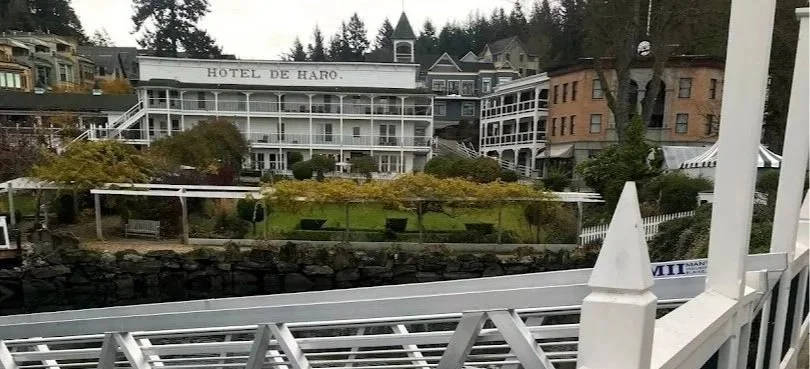
In my twenties I worked for a historical hotel at a dilapidated seaside resort on San Juan Island. Its greatest claim to fame was that Teddy Roosevelt had slept there, and hotel clerks dutifully schlepped the antique guest roster featuring his name in its heavy wood and glass case back and forth from the lobby to the back offices. Locally it was also known for more sinister events.
In the not-so-distant past, a love triangle had formed between year-round employees over a damp and insular winter. The jealous boyfriend had stalked his unfaithful lover and found her in a compromising position with one of their co-workers, the two of them tangled together on the chintz cover of one twin bed in the shabby off-season hotel. In a fit of passion, he shot them both and then himself. The housekeepers whispered that the blood stains could still be seen around the baseboards in Room 8, faded in amongst the outdated flowery wall-paper and the tired carpet.
The hotel was also said to be haunted by Ada, the ghost of the nanny for the family that had owned the limestone quarry at Roche Harbor in the late 1800’s and early 1900’s. What was now the resort restaurant had been the family home, and the executive dining room at the top of it was rumored to be Ada’s favorite place to haunt.
As the night clerk, it was my job to turn off all the lights in the hotel and lock the doors before leaving late each evening. I have always been a scaredy-cat, and when scheduled for the night shifts I would prudently go directly upstairs and turn off all the lights and shut each room’s door before the housekeeping crew and hotel manager had left for the day. This particular afternoon, I felt charged and sensitive as I moved down the hall past Room 8 at the top of the stairs. The narrow steps creaked as I climbed up them, and the low-slung afternoon autumn sunshine slanting through the wavy, antique windows, illuminated the mobiles of dust motes hanging in the still air.
My habit had been to make my way across the crooked floorboards to the suite on each floor, negotiate the labyrinth of vintage furniture to the small bathroom, and work my way through each room, checking to make sure that they were ready for any spontaneous guests that might check in on a quiet, fall evening. The hotel gave one the feeling that wherever you were, there was someone on the other side of the emptiness. In a closet, around a door, on the top floor when you were in the bowels of the laundry room or under the stairs. A glimpse of movement in the watery reflection of an old standing mirror. The in-house phone would ring sporadically and when you placed the receiver up to your ear, the underwater phone cables seemed to be trying to convey some garbled message. Eventually, after too many calls to make sense, I would just answer the phone and say, “Hi Ada! How are you?”
Once I had turned all the lights out and shut all the doors in the hotel, it was time to stand watch at the front desk and mind the resort phone as the shadows lengthened and the shorter day came to an end. Off season was a solitary time, with just the bare-bones restaurant crew, the general property manager, and me to wait out the time clocks. The hotel was empty of guests and only a few condos were occupied, so I languished informally on the desk, chatting with my boyfriend on the phone to keep the heebie-jeebies away. I was very engaged with our conversation, yearning for him in that new romance sort of way, when a small, modestly dressed older woman materialized right in front of me on the other side of the desk. In the blink of an eye it took me to register her presence, she was gone, and the air in the lobby had a feeling of being emptier than a moment before.
The exclamation of surprise was still falling from my lips into my lover’s ear while I wondered if I had really seen her. I told him what had just happened, we marveled at the uber creepiness of it all. I was more surprised than frightened, and she hadn’t seemed menacing in any way, but the hotel felt less settled than usual. The pallid sun had warmed the wooden facade and the evening was turning crisp and dark in a way only a Pacific Northwest autumn can bring, so maybe that was why the hotel creaked and groaned ominously. Brooding dark trees and dripping moss coupled with the sharp chill in the air made everything more somber, foreshadowing the winter months to come. Unfortunately, I had ridden my motorcycle to work and parked it behind the hotel. I wasn’t relishing the idea of the cold ride home, even though it was less than a mile away.
The property manager bumbled by. When I told him about Ada he guffawed. “Ada?! What’s she doing over here?” He agreed that given how quiet the evening was and my recent ghost sighting, I could leave early. Then he disappeared into the darkness to make his erstwhile rounds.
With a sense of relief, I started packing up my things and closing down the front desk office. The hotel staircase reflected darkly in the window of the side door as I trundled Teddy Roosevelt’s precious signature and its protective case to the back office and quickly shut the doors. I switched off the last lights, plunging the hotel into complete blackness, then grabbed my backpack and coat and hurriedly shut and locked the door. A few faint lampposts illuminated the cobblestone pathway in front, and the heels of my boots clicked on the hard surface, making me feel exposed. I hastened up the side of the hotel and to the back parking area where the housekeeping carts were plugged in, waiting for the morning housekeepers to blearily begin tomorrow’s drudgery.
A light caught the edge of my peripheral vision. I glanced up to see the light in Room 8 shining through the vintage lace curtains.
That’s odd, I thought to myself, I’m sure I turned that off.
I looked up again, just in time to see the curtains move. The hair on my neck stood on end. I jumped on my motorcycle and popped it into first gear, spraying loose gravel on the old white boards of the hotel as I revved up the back hill, past the abandoned doctor’s house and the old green garden shed. The windows of the buildings stared back at me darkly. All except for Room 8, which shone like a beacon behind me.